
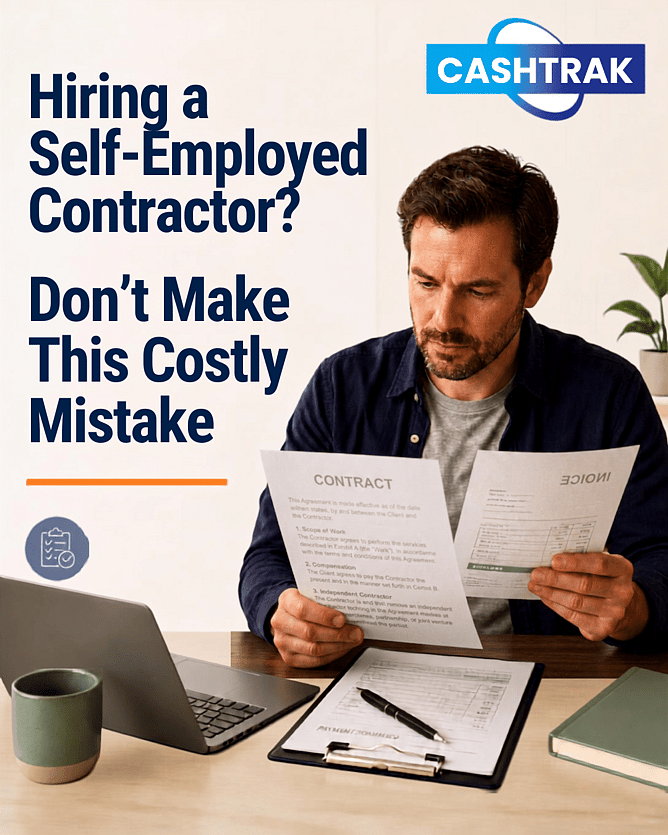
One of our clients recently contacted us for guidance about bringing someone into their growing business on a self-employed basis, with the intention of potentially offering employment in the future if the workload became consistent enough.
It's a question we are being asked more and more often by small business owners. As businesses grow, there often comes a point where extra help is needed, but committing to an employee straight away may not be financially viable.
In this case, our client had done a fantastic job of researching the differences between a self-employed contractor and an employee before approaching us. However, employment status is an area where many business owners unintentionally get things wrong, which can have costly consequences.
We thought this would make a useful topic for a blog.
Self-Employed or Employee?
Many business owners assume that if somebody submits invoices rather than receiving wages, they must be self-employed.
Unfortunately, it isn't that simple.
HMRC looks at the reality of the working relationship, not just what the parties choose to call it. A person can be described as "self-employed" and still be deemed an employee for tax purposes if the working arrangement has the characteristics of employment.
Some indicators of genuine self-employment include:
Being free to work for other clients.
Using their own equipment and resources.
Having their own insurance.
Deciding how and when the work is carried out.
Bearing some financial risk.
No single factor is decisive. HMRC will consider the overall picture.
Why Does It Matter?
Getting employment status wrong can be expensive.
If HMRC concludes that someone should have been treated as an employee, they may seek:
Outstanding PAYE tax.
Employer's National Insurance.
Employee's National Insurance.
Interest on late payments.
Penalties for non-compliance.
In some cases, the business owner can find themselves facing an unexpected bill covering several years. The fact that both parties agreed the worker was self-employed is unlikely to be enough to prevent HMRC from challenging the arrangement if the facts suggest otherwise.
There can also be wider implications, including employment rights claims relating to holiday pay, pensions, sick pay and other statutory entitlements.
You've Established They're Self-Employed. What Should You Do Next?
Once you're satisfied yourself that the arrangement is genuinely self-employed, don't stop there.
One of the biggest mistakes we see business owners make is relying on a verbal agreement or a few WhatsApp messages to define the relationship. While this may seem sufficient when everyone is getting along, problems can arise later if expectations differ or HMRC ever questions the arrangement.
A well-drafted contractor agreement helps protect both parties by clearly setting out how the relationship will work from day one. It won't automatically make someone self-employed in HMRC's eyes, but it does provide important evidence of the intentions of both parties and can help demonstrate that the arrangement has been structured correctly.
At a minimum, the agreement should cover:
Confirmation that the individual is operating as a self-employed contractor.
Responsibility for their own Income Tax and National Insurance.
Responsibility for arranging and maintaining appropriate insurance.
How and when they will invoice for work completed.
Payment terms.
The fact that there is no obligation on the business to offer work.
The fact that there is no obligation on the contractor to accept work.
Notice periods and termination arrangements.
Confidentiality requirements.
Data protection responsibilities.
Ownership of client relationships and business information.
There are plenty of template agreements available online and, increasingly, businesses are using AI tools to create a first draft. However, whichever route you choose, it is important to ensure the document reflects the reality of the working relationship, not just what you would like it to be.
What About HMRC's CEST Tool?
HMRC provides a free online service called Check Employment Status for Tax (CEST) which is designed to help businesses determine whether a worker should be treated as employed or self-employed for tax purposes. HMRC states that it will stand by the result provided that the information entered is accurate and the working arrangements match the answers given.
You can access the tool here:
https://www.gov.uk/guidance/check-employment-status-for-tax
The tool asks a series of questions about:
Who controls the work being carried out.
How the worker is paid.
Whether the worker can send a substitute.
Responsibility for equipment and expenses.
The contractual arrangements between the parties.
The day-to-day reality of the working relationship.
In theory, it sounds straightforward.
In practice, many business owners find the questions surprisingly difficult to answer. Terms such as "control", "substitution" and "mutuality of obligation" are not phrases most business owners use in everyday life, and it's easy to misinterpret what HMRC is actually asking.
We've seen situations where business owners complete the tool based on how they think the arrangement should work, rather than how it works in reality. Unsurprisingly, this can lead to unreliable results. Even organisations that provide tax guidance have highlighted the importance of understanding the questions properly before relying on the outcome.
Our recommendation? Use the tool, but don't use it in isolation if you're unsure.
Planning Ahead as Your Business Grows
Many businesses engage self-employed contractors as a way of managing growth before committing to taking on an employee.
In many cases, this can be a sensible approach. It provides flexibility for both parties while the business assesses whether there is sufficient ongoing work to justify a permanent role.
However, employment status is not something you assess once and then forget about.
Relationships evolve.
Someone who starts out completing occasional work on an ad hoc basis may, six months later, be working fixed hours every week, reporting directly to you, using your equipment and relying on your business as their only source of income.
At that point, the arrangement may begin to look much more like employment than self-employment.
That's why it's important to review arrangements regularly, particularly when a contractor becomes an increasingly important part of your business.
Need Help?
Employment status is one of the most commonly misunderstood areas of running a business, and unfortunately one of the most expensive to get wrong.
Whether you're taking on your first worker, engaging a contractor, or considering moving someone from self-employed status into employment, getting the right guidance at the outset can save significant time, stress and money later on.
Our team includes the Institute of Certified Bookkeepers' first-ever Payroll Professional of the Year, providing practical, in-depth guidance on:
Employment status.
Payroll.
Auto-enrolment pensions.
Employer responsibilities.
HMRC compliance requirements.
Growing your team correctly.
Thinking of taking someone on? Speak to us before you do. A quick conversation now could prevent a costly HMRC problem in the future and help ensure your business continues to grow on solid foundations.